
Running a business in Huntington means navigating New York’s strict workers compensation insurance requirements. Get it wrong, and you face hefty penalties and legal trouble.
At JW Hirschfeld Agency, Inc., we help Huntington employers cut through the confusion. This guide shows you how to stay compliant while saving real money on your premiums.
What New York Employers Must Know About Workers Compensation
New York State doesn’t give businesses a choice about workers compensation insurance. If you have employees, you must carry coverage. The penalty for non-compliance is severe: fines up to $2,000 per uninsured employee per day, plus potential criminal charges. Misclassifying workers as independent contractors to avoid coverage costs even more-fines can reach $5,000 per violation, and you’ll still owe back premiums plus interest. The New York Department of Labor actively audits payroll records, so the risk isn’t theoretical.
Your Coverage Must Meet State Minimums
New York mandates specific benefit levels in every workers compensation policy. Medical treatment for work-related injuries receives coverage without caps, meaning your policy pays for all necessary medical care, surgeries, and rehabilitation. Lost wage benefits replace two-thirds of an injured worker’s average weekly wage, up to a maximum amount set annually by the state.
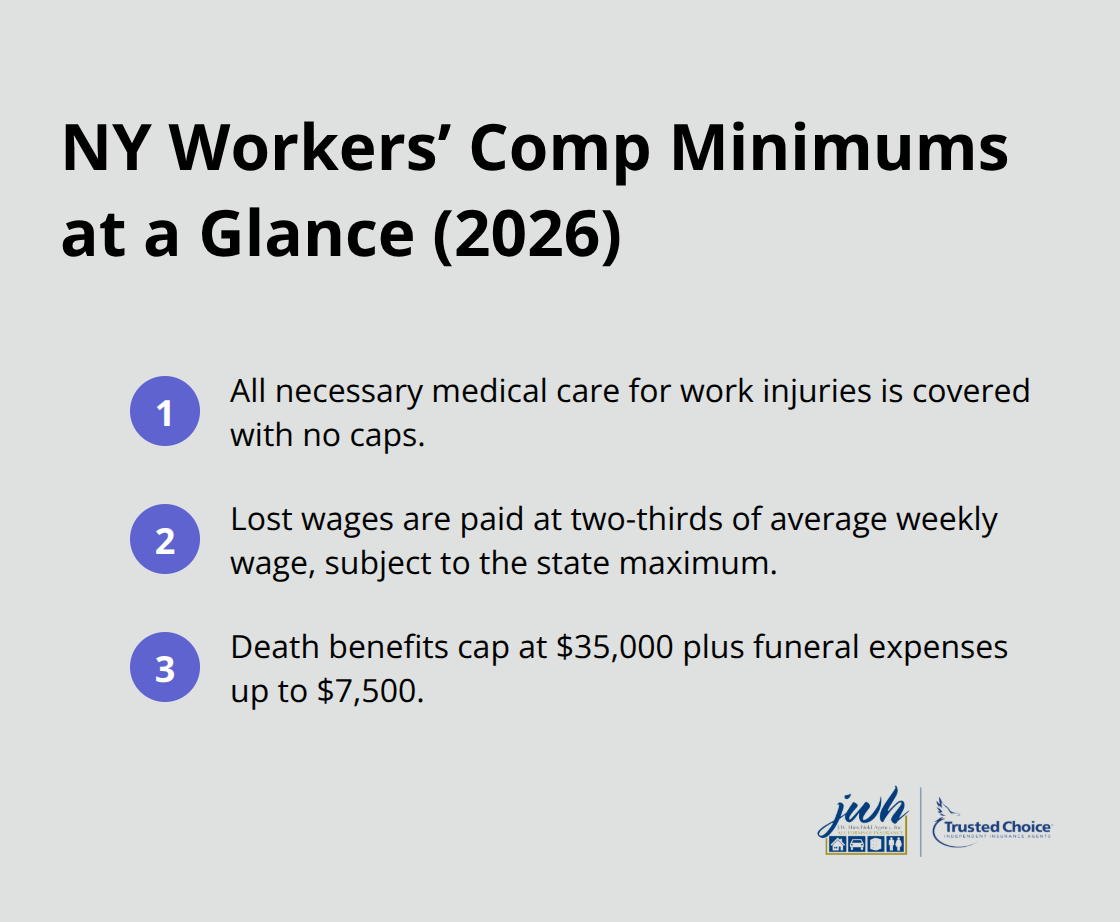
For 2026, the minimum weekly benefit is $384.45 for work-related injuries and illnesses occurring between July 1, 2026, and June 30, 2027. Death benefits go to the worker’s dependents and currently cap at $35,000 plus funeral expenses up to $7,500. These minimums apply regardless of which carrier you choose, so coverage differences come down to service quality, claims handling speed, and premium pricing.
Classification Accuracy Prevents Costly Audit Surprises
Your job classification codes determine your premium more than almost anything else. Misclassifying a worker into a lower-risk code artificially reduces your premium until the state audits you-then you face back premiums, penalties, and an adjusted experience modification rate that increases future costs. Construction companies often misclassify office staff into field roles, or administrative workers into higher-hazard categories. Retailers sometimes group all employees under a single code when cashiers, stockers, and managers carry different risk levels.
An independent broker verifies your classifications against your actual job duties before binding coverage. This step prevents the audit shock that surprises many Huntington business owners at renewal. JW Hirschfeld Agency, Inc., as a third-generation family-owned independent broker, represents multiple top carriers and works to identify these classification gaps before they become expensive problems. The difference between working with an independent agent and a captive carrier becomes clear when audit time arrives-independent brokers have already protected you.
How to Cut Workers Compensation Costs Without Sacrificing Protection
Huntington business owners often assume workers compensation premiums are fixed costs with little room to negotiate. That’s wrong. The carriers and coverage options available to you directly determine what you pay, and most businesses leave thousands of dollars on the table every year by not shopping aggressively or implementing proven cost-reduction tactics. Employers who take a strategic approach to their workers compensation program cut premiums by 15 to 25 percent while actually improving their claims outcomes and safety performance. The key is understanding where your premium dollars go and where you have real control.
Invest in Safety Programs to Lower Your E-Mod
Your workplace safety program moves the needle faster than anything else. Carriers measure risk partly through your experience modification rate, or e-mod, which compares your claim history to similar businesses in your industry. A strong safety program with documented training, hazard assessments, and incident investigation procedures lowers your claim frequency, which directly reduces your e-mod over time. One manufacturer in the Northeast invested $33,000 in ergonomic equipment and fall protection, then tracked their results over five years and achieved a 191 percent return on that investment through reduced claims and premium credits.
New York State supports this approach through programs like the MEM Safety Grants, which provide up to $10,000 per year in matching funds specifically for safety equipment purchases. Document everything: your training sessions, near-miss reports, corrective actions taken. Carriers reward this documentation with premium reductions because they see you’re serious about prevention. Claims data shows that roughly two-fifths of lost-time claims involve new hires, with an average cost of $52,200 per claim according to MEM data. This means post-offer employment testing and structured onboarding safety training for every new worker pay for themselves in avoided claims within months.
Compare Quotes Across Multiple Carriers
The second lever is comparing actual quotes across multiple carriers rather than accepting whatever your current insurer offers at renewal. This is where independent agents deliver real value that large carriers cannot. When you work with an independent broker, you access multiple top-tier carriers simultaneously instead of being locked into one company’s pricing. Captive agents represent only their employer’s products, so they cannot show you what competing carriers charge for the same coverage. Independent agents can quote your exact risk profile across five, ten, or more carriers in days, not weeks.
You’ll see real differences: one carrier might charge 18 percent less for your specific classification mix while another offers superior claims support or safety consulting at the same price. Some carriers bundle workers compensation with your general liability, property, or commercial auto policies and apply multi-policy discounts that can reduce your total premium by 10 to 20 percent. You won’t find these options unless you compare them side by side. Request quotes that show the same coverage limits, deductibles, and classifications across all carriers so you’re comparing apples to apples. This transparency matters because some carriers offer lower base rates but narrower coverage, while others include value-added services like in-house nurse case management or telehealth triage that reduce claim costs after an injury occurs.
The right independent broker represents multiple top carriers and works to identify cost-saving opportunities specific to your business. This competitive shopping process-available only through independent agents-protects your bottom line in ways that captive carriers simply cannot match. Your next step involves gathering your current payroll records and job classifications to prepare for accurate quotes.
Why Independent Agents Win on Price and Service
One Carrier Versus Multiple Carriers
Captive insurance agents work for one company and sell only that company’s products at that company’s prices. Independent agents represent multiple carriers, which fundamentally changes what they can deliver. When you request a quote from a captive agent, you see one option. When you request a quote from an independent broker, you see genuine market competition. Carriers price workers compensation differently based on their underwriting appetite, claims philosophy, and regional strategy.
One carrier might aggressively price manufacturing risks while another focuses on retail. One might offer superior safety consulting and return-to-work support while another competes purely on rate. Without access to multiple carriers simultaneously, you cannot see these tradeoffs or identify which carrier’s strengths align with your business. Independent brokers quote your risk across multiple top-tier carriers in parallel, which means you see actual rate differences, coverage variations, and service offerings side by side.
Transparency Reveals Hidden Opportunities
A retailer with 25 employees might find that Carrier A charges 12 percent less but excludes part-time workers from certain benefits, while Carrier B costs 8 percent more but includes comprehensive coverage for temporary staff and offers a dedicated claims advocate. The price difference becomes irrelevant once you understand what each option actually covers. Captive agents cannot show you this comparison because they represent only one carrier.
Independent brokers also conduct deeper risk assessments before quoting because they work for you, not for an insurer. A captive agent processes your application and sends it to underwriting. An independent broker interviews you about your actual operations, reviews your job classifications against your documented duties, and identifies potential coverage gaps before they become audit problems. This assessment costs nothing upfront but saves thousands later.
Risk Assessment Prevents Costly Mistakes
One Huntington business owner accepted a quote from a captive agent without realizing their office staff were misclassified into a field-work code, which artificially reduced their premium by roughly 18 percent. The state audit eighteen months later resulted in back premiums, penalties, and a permanently elevated experience modification rate. An independent broker would have caught this during the initial risk review.
After an injury occurs, independent brokers become your advocate through the claims process in ways captive agents typically do not. If an employee files a questionable claim or if medical bills seem excessive, an independent broker with access to in-house nurse case management and telehealth triage can challenge costs and coordinate faster, more cost-effective care.
Local Knowledge Shapes Better Coverage
The local presence matters significantly. Independent brokers operating in Huntington understand the specific risks facing local businesses-seasonal hiring patterns, local labor market conditions, regional safety concerns. This knowledge influences how brokers structure your coverage and which carriers they recommend for your particular industry and size. A third-generation family-owned independent broker in Huntington represents multiple top carriers and works to identify cost-saving opportunities specific to your business. This competitive shopping process-available only through independent agents-protects your bottom line in ways that captive carriers simply cannot match.
Final Thoughts
Compliance and cost management in Huntington workers’ compensation insurance work together, not separately. Businesses that invest in documented safety procedures, accurate job classifications, and proper claims management simultaneously lower their premiums and reduce their legal exposure. The employers who struggle financially treat workers compensation as a fixed cost rather than a controllable expense that responds to strategic action.
Your next step involves two actions. First, verify your current coverage meets New York’s minimum benefit standards and that your job classifications match your actual work duties. Second, compare your current premium against quotes from multiple carriers to identify rate differences and service gaps you may not know exist.
Most Huntington business owners discover they overpay by 15 to 25 percent simply because they never shopped competitively or because their current carrier lacks the safety consulting and claims support that reduce long-term costs. JW Hirschfeld Agency, Inc. represents multiple top carriers and conducts the risk assessment work upfront to prevent costly misclassifications and coverage gaps. Contact them for a free quote and risk review-the conversation costs nothing, but the insights often save thousands.
The information provided in this blog is for general informational purposes only and does not constitute legal, financial, or insurance advice. Coverage options, terms, and availability may vary. Please consult with a licensed professional for advice specific to your situation.
Artificial intelligence may have been used to generate text and images in some blog articles.