
One accident on your job site can wipe out months of profit. Builder contractor insurance LI protects you from the financial fallout of injuries, property damage, and project delays that happen in construction.
At JW Hirschfeld Agency, Inc., we’ve helped Long Island builders find coverage that actually fits their operations. This toolkit walks you through what you need to know.
What Your Builder Insurance Actually Protects
General Liability Covers Third-Party Claims, Not Your Property
General liability covers third-party claims, helping cover the cost of accidents, property damage and bodily injury claims from clients, visitors, or subcontractors on your job site. GL pays medical costs, legal defense, and settlement expenses when someone else is injured or their property is damaged. The key is understanding what GL does not cover: your own property damage, employee injuries (that’s workers’ compensation), or professional mistakes in design work.
Builder’s Risk Protects Your Work in Progress
Builder’s risk insurance fills a different gap entirely. This temporary, project-specific policy protects the structure itself, materials on site, and temporary structures during construction. Coverage starts before materials arrive and ends when the property is occupied or sold. If fire, vandalism, theft, or weather damages your work in progress, builder’s risk pays to repair or replace it. Many policies also cover soft costs like lost rental income, extra loan interest, and real estate taxes if a covered loss delays the project.
The Critical Gap: Tools, Equipment, and Materials
Most builders assume general liability protects their tools, equipment, and materials at the job site. It does not. GL covers third-party claims, not your own property losses. If thieves steal your equipment or a weather event damages materials stacked on site, GL leaves you exposed. Inland marine coverage (sometimes called contractors’ equipment insurance) protects tools and equipment transported between job sites and stored on location. This is essential if you carry high-value gear or move equipment frequently across Long Island projects.
How the Three Policies Work Together
Builder’s risk handles materials and structures under construction, while inland marine handles your portable assets. Combining all three closes the exposure gap that catches unprepared contractors off guard. GL protects other people, builder’s risk protects the project, and inland marine protects your equipment.
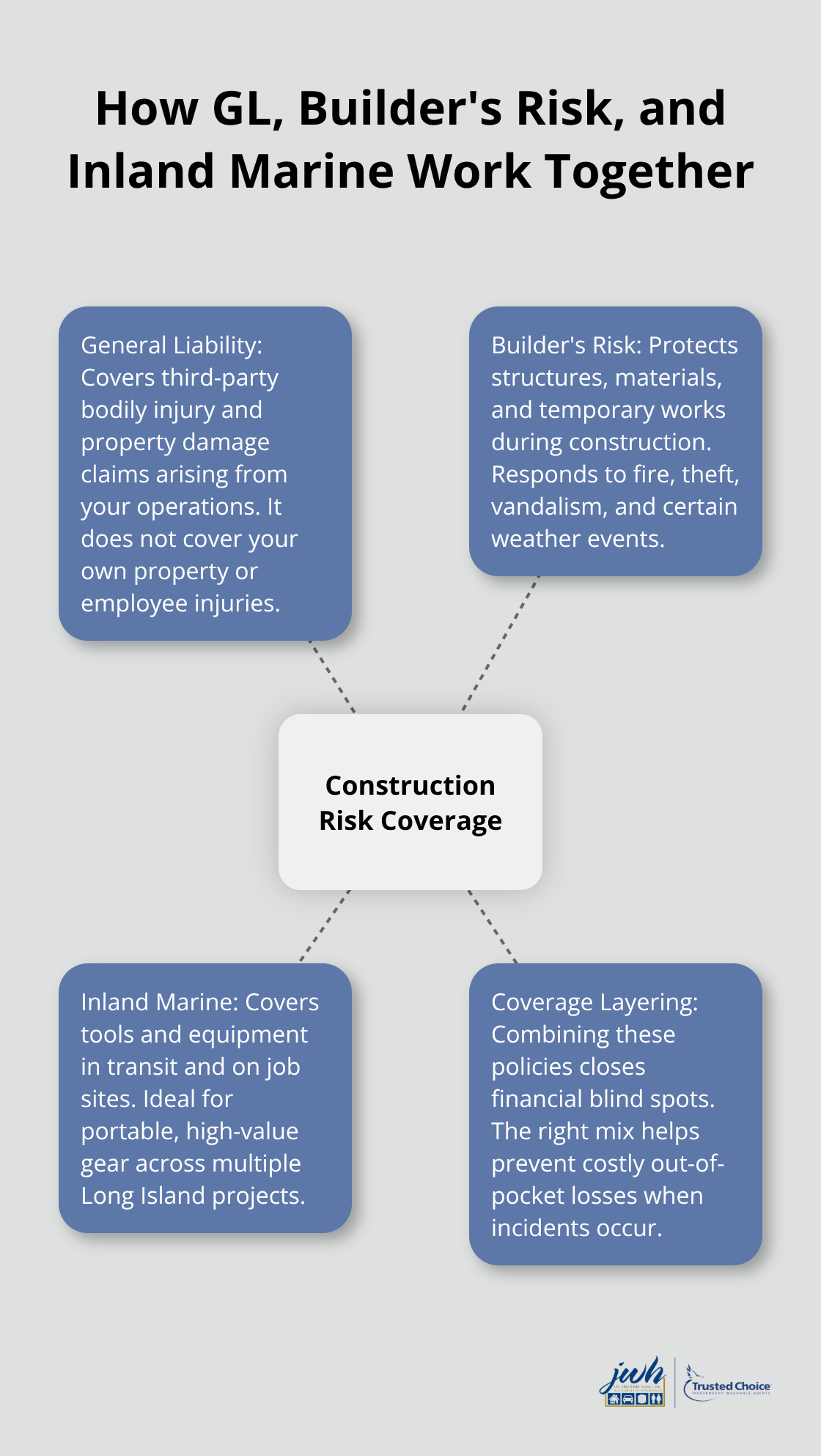
Missing any of these three creates a financial blind spot that can cost thousands when something goes wrong. An independent insurance agent can help you identify which gaps matter most for your specific operations and ensure you’re not paying for coverage you don’t need while leaving critical exposures unprotected.
What Really Happens When Claims Hit Your Job Site
Third-Party Injuries Cost Contractors Thousands Fast
On Long Island, a single slip-and-fall incident costs the average contractor average settlements range from $30,000 to $60,000, with serious injuries reaching significantly higher amounts in medical bills, legal fees, and settlement payouts before insurance steps in. General liability covers these third-party injury claims, but too many builders discover too late that GL alone leaves them exposed to property damage lawsuits that drain cash reserves in weeks. A subcontractor’s negligence that damages a client’s adjacent property, theft of materials stacked on site, or fire spreading to neighboring structures creates liability exposure that GL wasn’t designed to handle.
Property Damage and Weather Losses Compound Quickly
Builder’s risk fills this gap by protecting the structure and materials under your control, while inland marine insurance covers your equipment and tools moving between projects. The combination matters because construction sites attract multiple risk vectors simultaneously-weather, theft, accidents, and third-party injuries all happen on the same job. Without proper coverage layering, you end up choosing which financial disaster to absorb.
Weather-related claims represent a significant portion of construction losses on Long Island, particularly during hurricane season. A project delay caused by storm damage doesn’t just stop work; it triggers cascading costs including extended loan interest, lost rental income for completed phases, and overhead expenses that keep accumulating.
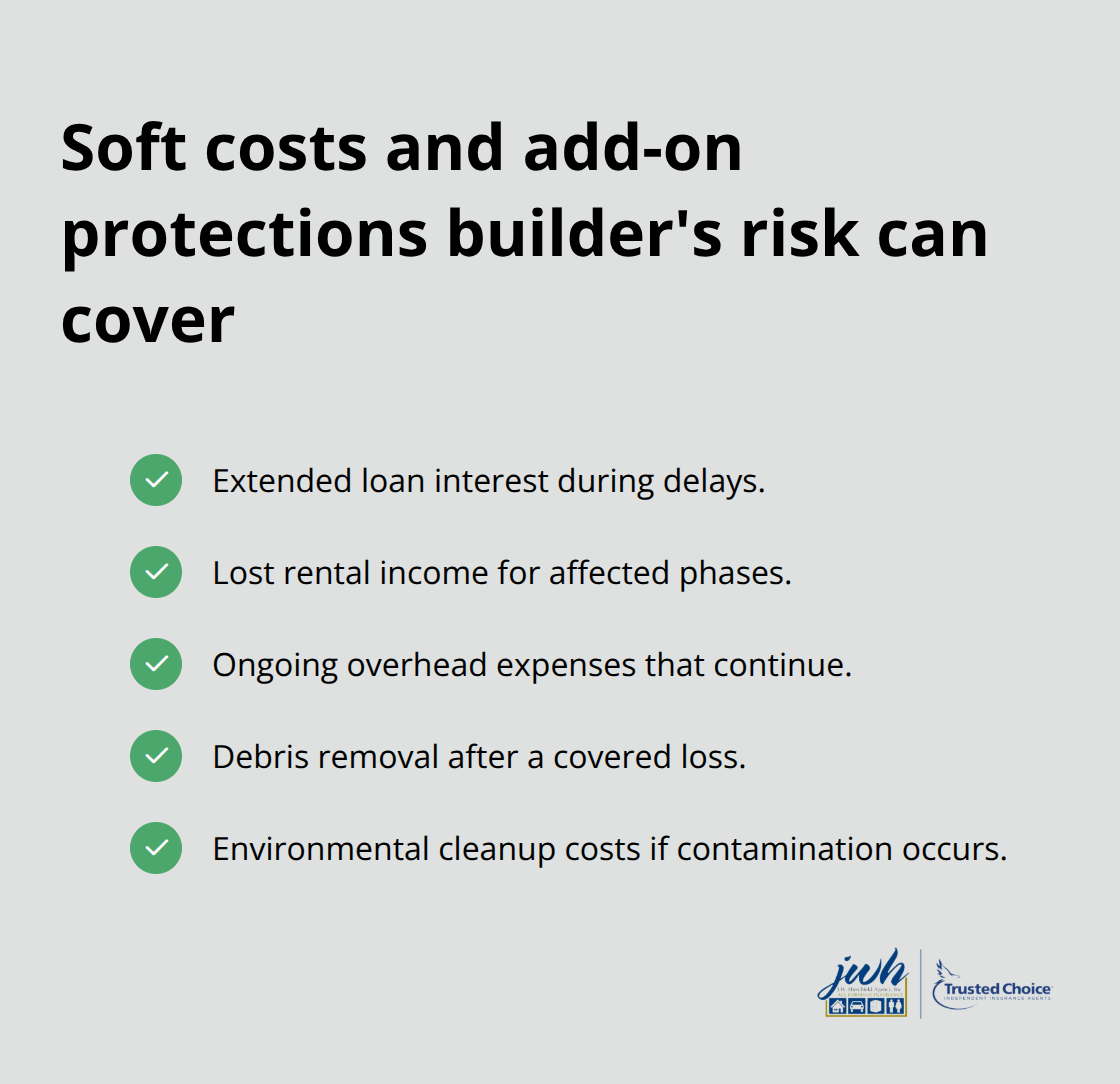
Builder’s risk policies that include soft cost coverage reimburse these indirect losses, protecting your profit margin when circumstances beyond your control halt progress. Many policies also cover debris removal and environmental cleanup costs if contamination occurs during weather events, which saves thousands in remediation expenses.
Customized Coverage Protects Against Hidden Exposures
The key difference between contractors who recover quickly from setbacks and those who struggle financially comes down to whether their insurance was customized for their specific project risks. Generic policies from big-box insurers apply one-size-fits-all limits and exclusions that don’t account for Long Island’s unique construction environment, seasonal weather patterns, or the types of materials and equipment your operation relies on. An independent agent works directly with multiple carriers to build policies that match your actual exposures rather than forcing you into standard templates designed for national averages. This customization means your coverage limits reflect your project values, your deductibles align with your cash flow capacity, and your exclusions don’t hide surprises when you file a claim.
Workers’ Compensation and Third-Party Claims Require Different Coverage
Injury claims from workers and subcontractors require separate coverage-workers’ compensation-which operates independently from general liability. New York law mandates workers’ comp for any contractor with employees, and the cost of skipping this protection ranges from significant fines to personal liability if someone is injured. Third-party injuries from your operations fall under GL, but distinguishing between an employee injury and a third-party injury determines which policy responds. Accurate policy classification becomes essential when you manage mixed crews on complex projects, and this is where independent agents help contractors avoid costly misclassifications that leave gaps when claims arise.
Why Independent Agents Win for Long Island Contractors
National Carriers Apply One-Size-Fits-All Templates
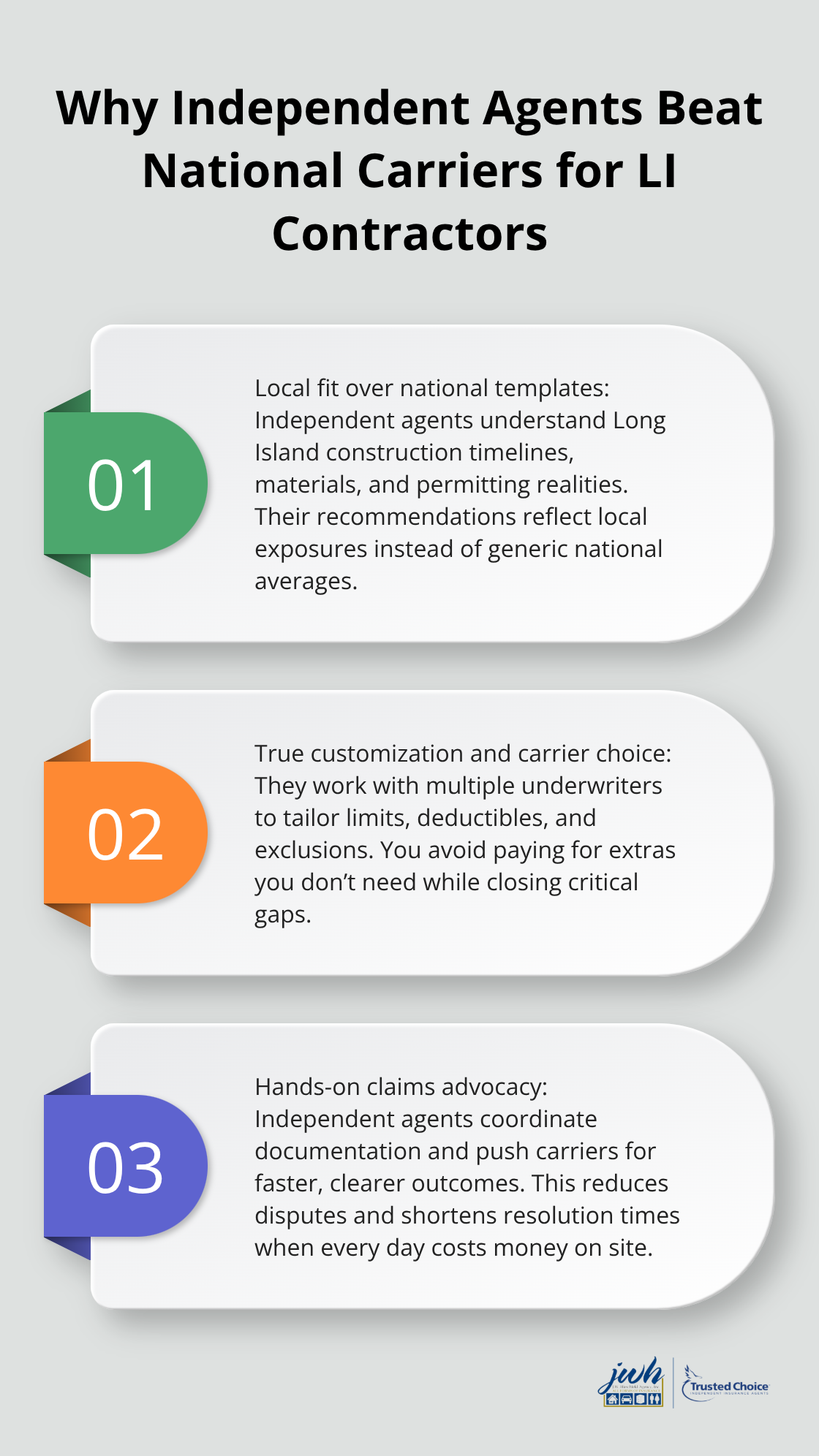
Big-box insurers operate on volume and standardization. They plug your information into algorithms, generate a quote based on national risk models, and move to the next customer. This approach works fine for someone purchasing homeowners insurance, but it fails contractors who operate in Long Island’s specific construction environment with project-specific exposures that national templates don’t capture. Independent insurance agents represent multiple top carriers and have the authority to customize policies rather than force you into rigid programs designed for average markets. When you work with an independent agent, you’re not receiving a one-size-fits-all quote-you’re accessing carriers competing for your business and agents who understand how Long Island construction actually works.
Customization Cuts Costs and Closes Coverage Gaps
National carriers maintain strict underwriting guidelines that leave little room for negotiation on coverage limits, deductibles, or exclusions. If your project profile doesn’t fit their template perfectly, you either accept their terms or move to another national carrier that applies the same rigid framework. Independent agents eliminate this constraint by working directly with multiple underwriters who evaluate your specific risk profile and customize terms accordingly. A contractor managing renovation work across multiple properties in different Nassau County neighborhoods faces different exposures than someone building new commercial structures in Suffolk, yet national carriers treat both identically. Independent agents know these distinctions matter and build policies that reflect your actual operations rather than statistical averages. This customization results in lower premiums compared to national carriers because you pay only for coverage you actually need and exclusions don’t hide unnecessary gaps.
Local Relationships Accelerate Claims Resolution
When a claim happens, having an agent who knows your operation and your local market dramatically accelerates the claims process. National carriers route claims through regional processing centers where adjusters unfamiliar with Long Island construction timelines and local practices apply generic claim procedures. An independent agent advocates directly with the carrier on your behalf, understands the documentation your operation produces naturally, and maintains relationships with adjusters who know how construction projects actually function. This personal advocacy cuts claim resolution time significantly and reduces disputes over coverage interpretation. Having someone fighting in your corner rather than a customer service line reading from a script makes a real difference when you need it most.
Final Thoughts
Builder contractor insurance LI works best when it matches your actual operations rather than forcing you into templates designed for contractors elsewhere. General liability protects third-party claims, builder’s risk protects structures and materials under construction, and inland marine coverage protects your tools and equipment moving between job sites. Workers’ compensation remains mandatory under New York law and operates separately from these policies, and the combination of all four closes the exposure gaps that catch unprepared contractors off guard.
Getting a tailored quote requires more than entering numbers into an online form. You need an agent who understands your specific project types, your equipment values, your local market conditions, and your cash flow capacity to set appropriate deductibles. Bring details about your current and projected revenue, the types of projects you manage, your claims history, and any contract requirements your clients impose so an agent can customize limits and exclusions that actually protect your business.
We at JW Hirschfeld Agency, Inc. work directly with multiple top carriers to build policies that fit Long Island construction operations specifically. Contact JW Hirschfeld Agency, Inc. for a quote that reflects your actual operations, and we’ll review your project profile, identify coverage gaps, and show you how independent representation saves money while closing exposures that national carriers miss.
The information provided in this blog is for general informational purposes only and does not constitute legal, financial, or insurance advice. Coverage options, terms, and availability may vary. Please consult with a licensed professional for advice specific to your situation.
Artificial intelligence may have been used to generate text and images in some blog articles.