

Employer workers compensation requirements vary significantly by state, and getting them wrong can cost your business thousands in fines. Most states mandate coverage once you hit a certain employee threshold, but the rules differ depending on your industry and location.
At JW Hirschfeld Agency, Inc., we help employers navigate these complex regulations and find coverage that actually protects their bottom line. This guide breaks down what you’re legally required to provide, how to manage costs, and why working with a local independent agent makes compliance simpler.
Workers Compensation Coverage Requirements by State
Mandatory Thresholds Vary Dramatically Across States
Every state sets different worker’s compensation thresholds, and most employers misunderstand their obligations. New York requires coverage if you have even one employee on payroll, according to the New York State Workers Compensation Board. Texas takes the opposite approach-it’s one of the few states where workers compensation is optional for most private employers, though general contractors and certain industries still face mandatory requirements. California requires coverage at one employee, while Florida requires it at four employees.
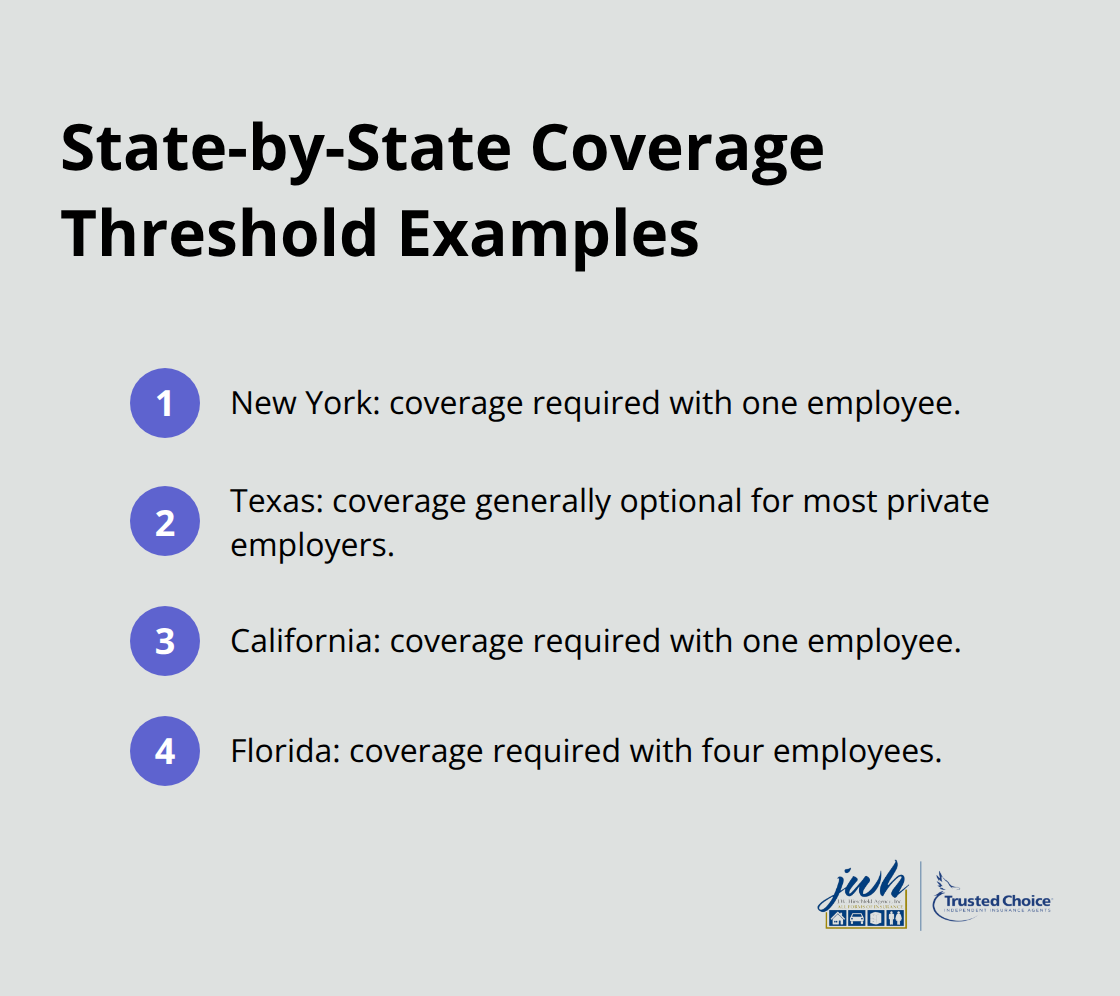
Your neighboring state’s rules do not apply to your business, so you must verify your specific state’s requirements.
Non-compliance carries steep financial consequences. States like New York and California impose fines that reach $10,000 per month for operating without required coverage. Massachusetts can fine you up to $500 per day. Beyond fines, an uninsured employee injury exposes you to personal liability for all medical costs and lost wages.
Exemptions and Misclassifications Create Hidden Risks
Certain workers fall into exemptions that trip up employers constantly. Sole proprietors, partners, and LLC owners often don’t need to cover themselves in most states, but only if they meet specific ownership thresholds (typically owning at least 50% of the business). Family members sometimes qualify for exemptions too, though rules vary by state. Independent contractors generally don’t require coverage under your policy, but misclassifying an employee as a contractor triggers state audits and back-payment demands.
Construction companies face stricter rules than other industries; subcontractors must typically carry their own coverage or appear on your policy. Agricultural businesses, domestic workers, and seasonal employees create additional complexity depending on your state. These classifications matter enormously because state enforcement actions carry significant financial consequences.
What Comes Next
Understanding your state’s specific thresholds and exemptions forms the foundation of compliance. The next step involves knowing exactly what benefits and protections your coverage must actually provide to employees.
What Your Workers Compensation Policy Must Cover
Medical Benefits Cover All Work-Related Treatment
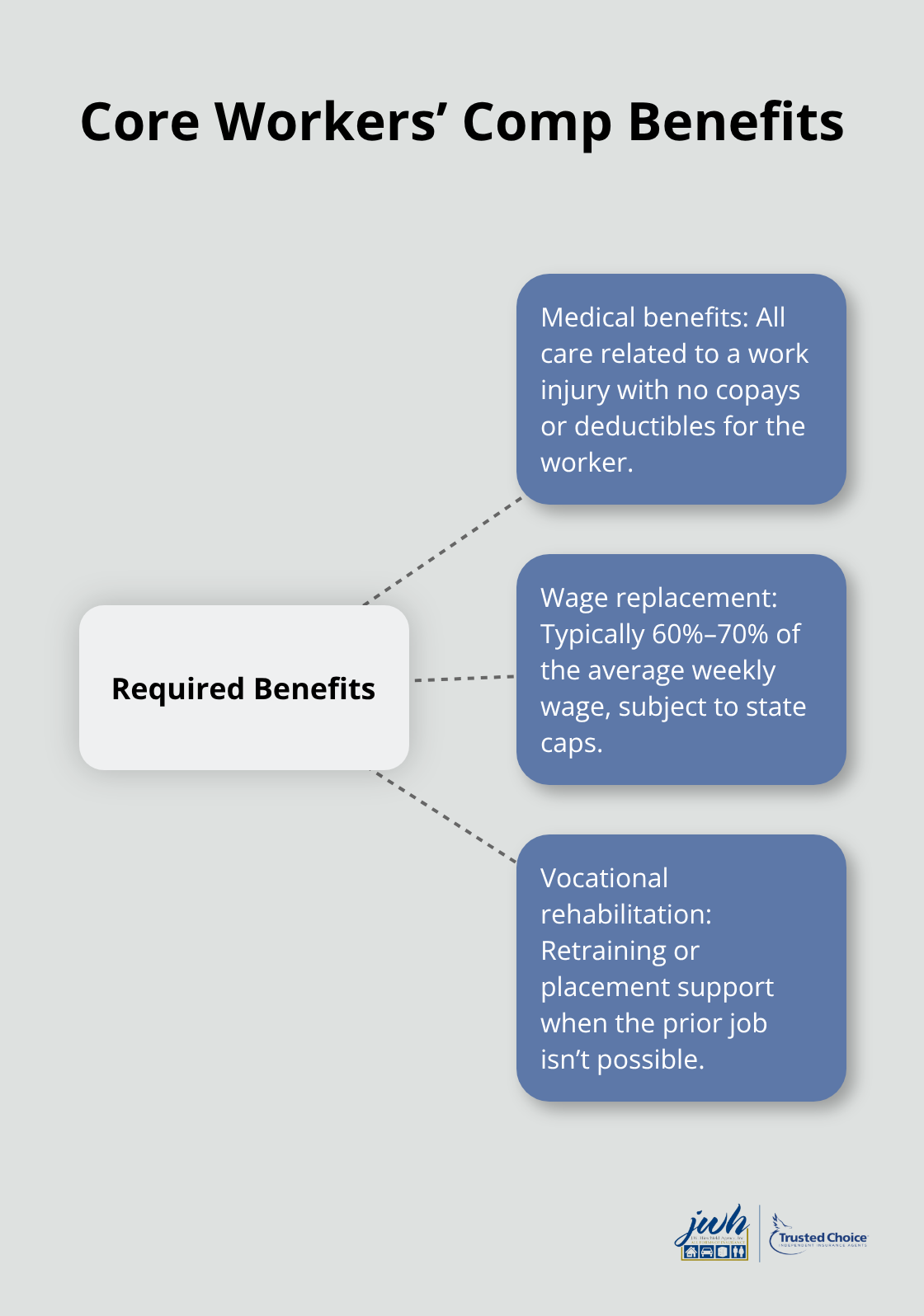
State laws dictate exactly what medical and income benefits employers must provide through workers compensation insurance, and the coverage extends far beyond what most business owners realize. Medical benefits cover all treatment related to a work injury, including emergency care, surgeries, hospital stays, prescription medications, physical therapy, and ongoing specialist visits-with no copays or deductibles for the injured worker. If an employee suffers a back injury on the job, your policy pays for the initial ER visit, MRI scans, orthopedic consultations, and six months of physical therapy without the employee paying anything out of pocket. Your state determines which treatments qualify as work-related, and carriers must approve medically necessary care without delay.
Wage Replacement Benefits Compensate Lost Income
Wage replacement benefits activate after a short waiting period, typically three to seven days depending on your state, and compensate workers for lost income while they recover. Most states replace between 60% and 70% of the worker’s average weekly wage, according to the National Council on Compensation Insurance, with maximum benefit caps that vary by state. These payments continue until the worker returns to work or reaches maximum medical improvement, protecting both the employee and your business from financial strain.
Vocational Rehabilitation Helps Workers Transition
Vocational rehabilitation services provide retraining or job placement assistance when an injured worker cannot return to their previous position. These services might include skills assessments, job coaching, or tuition assistance for certificate programs, allowing workers to transition into new roles rather than remaining permanently disabled. Your state’s workers compensation board administers these programs to help injured employees re-enter the workforce productively.
Control Costs Through Safety and Claims Management
Workers compensation costs rise directly with claim severity and frequency, making your actual premium far more controllable than most assume. Insurance carriers calculate premiums using your experience modification rate, which tracks your claims history against industry benchmarks-a metric that improves significantly when you maintain strong safety protocols and return-to-work programs. Employers who invest in ergonomic workstations, equipment maintenance, and employee safety training typically see experience modification rates 20% to 30% lower than industry average, translating to substantial annual savings. Understanding these benefit requirements upfront helps you budget accurately and build workplace safety strategies that reduce both injuries and insurance costs over time.
The next critical step involves implementing the specific cost management and risk reduction strategies that actually lower your premiums while protecting your workforce.
How to Lower Workers Compensation Costs Without Cutting Corners
Your Premium Reflects Daily Workplace Decisions
Your workers compensation premium isn’t fixed-it responds directly to decisions you make every day at your workplace. The experience modification rate that insurers use to calculate your premium reflects your company’s injury frequency and severity. Employers who maintain rigorous safety protocols and structured return-to-work programs consistently achieve experience modification rates 20% to 30% below industry average, which translates into thousands of dollars in annual savings. The National Council on Compensation Insurance reports that proactive employers reduce claim costs by up to 40% through targeted loss prevention efforts.
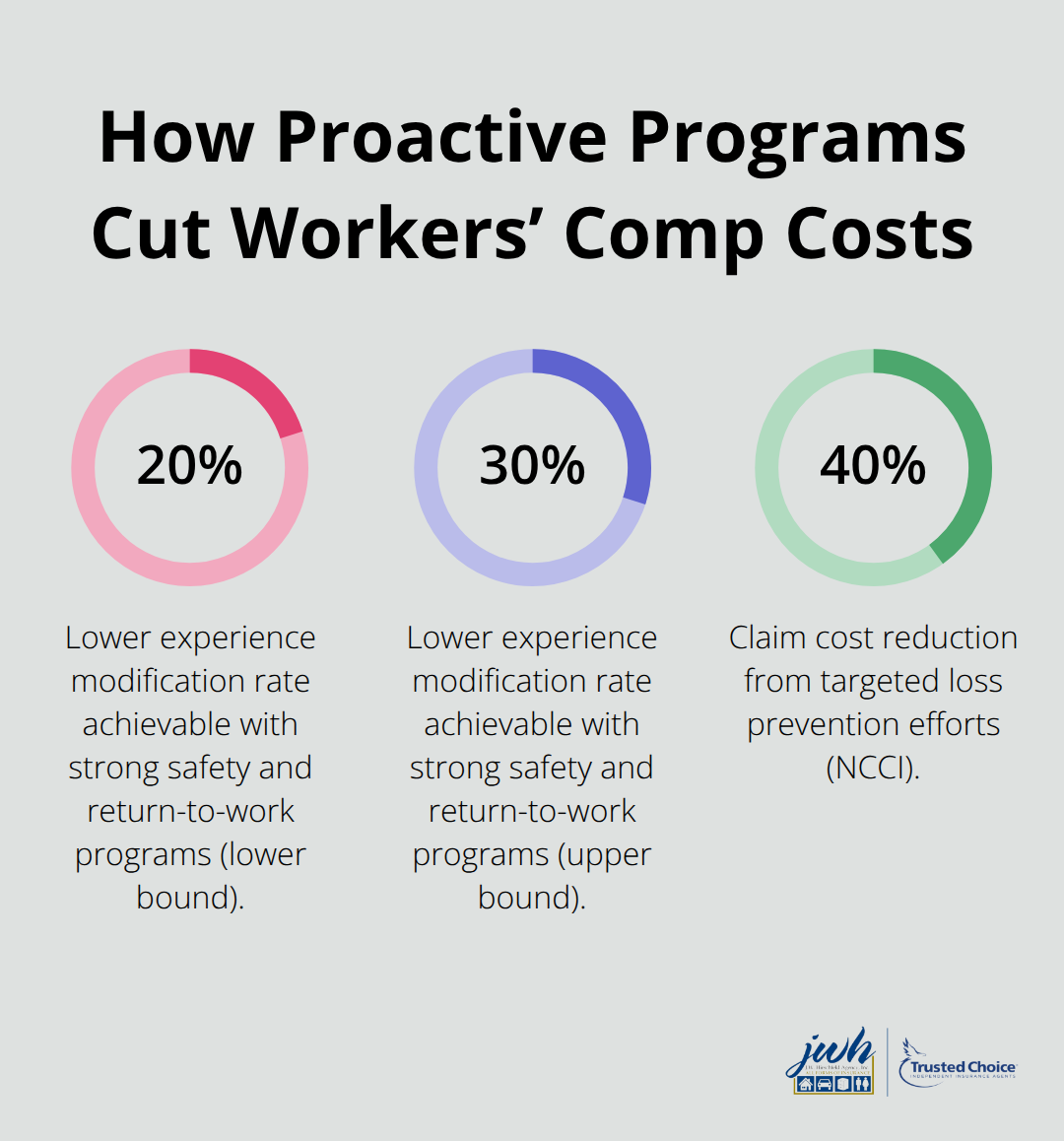
Safety investments pay for themselves through lower premiums, fewer work disruptions, and reduced employee turnover.
Build a Foundation With Hazard Assessment and Controls
Start with a detailed hazard assessment specific to your industry and job roles-don’t rely on generic safety checklists. Identify which tasks produce the highest injury rates, then implement engineering controls that eliminate or reduce those hazards. Warehouse operations that add mechanical lifting equipment reduce back injuries far more effectively than safety training alone. Ergonomic improvements to workstations, proper equipment maintenance schedules, and clear safety procedures form your foundation. Track near-miss incidents as aggressively as actual injuries because they reveal hazard patterns before someone gets hurt. When you report these metrics to your insurance carrier, many will offer premium discounts or loss control services at no additional cost.
Structured Return-to-Work Programs Cut Disability Duration
Return-to-work programs matter far more than most employers realize because they directly control how long an injured worker remains off payroll and collecting wage replacement benefits. Research from the American Journal of Industrial Medicine shows that a structured return-to-work process reduces disability duration by 50% or more. The program should start immediately after injury, not weeks later, with modified duty assignments that allow injured workers to contribute productively while they heal. Modified duty might mean lighter tasks, reduced hours, or different job functions that don’t aggravate the injury. Communicate with the injured worker’s physician about specific work restrictions and what activities the person can safely perform. Create a written return-to-work policy that clearly outlines these modified duty positions and how long they typically last.
Responsive Claims Management Minimizes Total Payouts
Claims management practices directly impact your bottom line because delayed claim processing extends disability periods and increases total benefit payouts. Respond to injury reports within 24 hours, not days, and promptly submit required documentation to your insurance carrier. Stay in regular contact with the injured worker, the treating physician, and your claims adjuster to address complications quickly. Many employers ignore small claims, assuming they won’t affect future premiums, but insurers track all claims regardless of size. Your local independent insurance agent can review your specific workers’ compensation loss history, identify patterns, and recommend targeted interventions that work for your particular operation (this personalized approach distinguishes independent agents from larger carriers that treat all clients with standardized solutions).
Final Thoughts
Employer workers compensation requirements form the backbone of workplace protection, and compliance isn’t optional-it’s a legal and financial necessity. States impose fines reaching $10,000 per month for non-compliance, and a single uninsured injury exposes you to unlimited personal liability for medical costs and lost wages. Getting these requirements right protects your employees from financial hardship after injury and shields your business from devastating liability claims.
Your path forward involves three concrete actions: verify your specific state’s coverage thresholds and exemptions immediately, implement cost management strategies like hazard assessments and structured return-to-work programs that reduce your experience modification rate by 20% to 30%, and work with someone who understands your specific operation. Independent insurance agents represent multiple top carriers and build personalized strategies around your business rather than applying standardized solutions to every client. They review your loss history, identify cost reduction opportunities specific to your industry, and advocate for you through claims-not just at policy renewal.
Contact JW Hirschfeld Agency, Inc. to audit your current coverage against your state’s specific employer workers compensation requirements and identify gaps or overpayment opportunities. This conversation costs nothing and typically reveals savings or protection improvements you didn’t know existed. An independent agent can help you navigate these complex regulations and find coverage that actually protects your bottom line.
The information provided in this blog is for general informational purposes only and does not constitute legal, financial, or insurance advice. Coverage options, terms, and availability may vary. Please consult with a licensed professional for advice specific to your situation.
Artificial intelligence may have been used to generate text and images in some blog articles.